

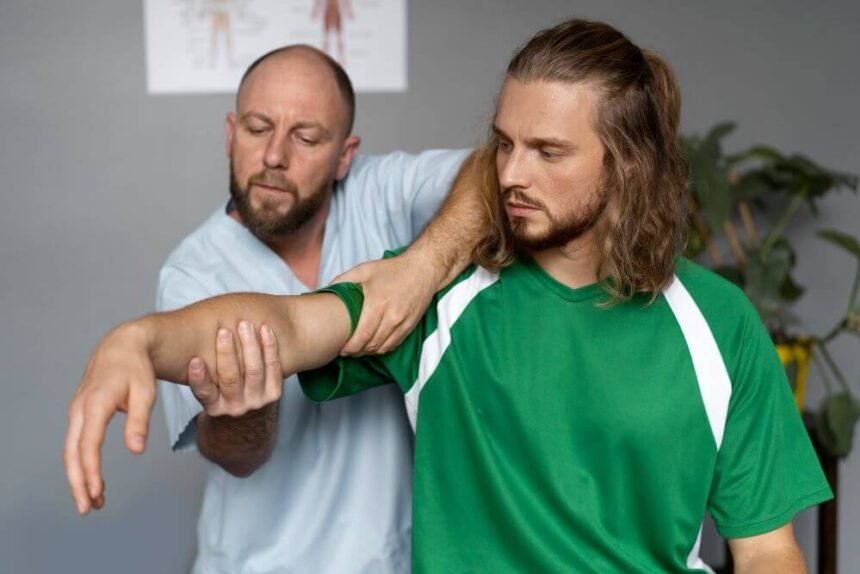
The shoulder is one of the most mobile joints in the human body — and that mobility comes with a corresponding vulnerability to injury, particularly in athletes who load the shoulder in overhead positions repeatedly. Swimmers, baseball and softball players, tennis players, volleyball players, and overhead weightlifters all place demands on the shoulder that eventually surface the joint’s structural limitations.
Understanding the injury patterns common to overhead athletes — and the prevention, recognition, and treatment approaches that address them — gives athletes and coaches a framework for managing shoulder health across a long career.
Why Overhead Athletes Are at Higher Risk
The overhead throwing and hitting motion generates forces at the shoulder that approach the structural limits of the joint’s ligaments and labrum. The rotator cuff — the group of four muscles that stabilize and rotate the shoulder — absorbs enormous loads during the deceleration phase of overhead motions, generating the eccentric muscle forces that are particularly associated with cumulative tendon damage.
Volume compounds vulnerability. A pitcher throwing 100 pitches multiple times per week, a swimmer logging miles of stroke cycles per day, or a volleyball player hitting hundreds of spikes in practice accumulates exposure that eventually causes the microtrauma associated with overuse injury, even with technically sound mechanics.
Common Overhead Athlete Shoulder Injuries
Rotator cuff tendinopathy — inflammation and degeneration of the rotator cuff tendons without a discrete tear — is the most common shoulder presentation in overhead athletes. It’s characterized by pain at the front or side of the shoulder with overhead activity, weakness with specific movements, and night pain that disrupts sleep.
Superior labrum anterior to posterior (SLAP) tears affect the cartilage ring around the shoulder socket, typically at the attachment point of the long head of the biceps. They’re particularly common in baseball pitchers and are caused by the extreme traction forces generated during the late cocking phase of the throw.
When to See a Specialist
Pain that persists beyond a few days of rest, weakness that limits overhead performance, a sensation of instability or clicking in the shoulder, or any acute event that produces immediate significant pain all warrant professional evaluation. A shoulder specialist Dallas TX with experience in overhead athlete presentation can distinguish between conditions that respond to conservative management and those that require more definitive intervention.
Early evaluation consistently produces better outcomes than deferred care. A rotator cuff issue addressed at the tendinopathy stage is far more manageable than a rotator cuff tear that developed because early warning signs went ignored. The athlete who sees a specialist at the first sign of a persistent problem typically has a shorter recovery and a smaller intervention than one who trains through pain for months.
Prevention Through Strengthening and Load Management
Rotator cuff strengthening — particularly for the external rotators, which are disproportionately weakened relative to the internal rotators in most overhead athletes — is the most evidence-supported prevention intervention for shoulder injury in this population. A structured shoulder care program that includes eccentric rotator cuff work, periscapular strengthening, and mobility maintenance is standard practice for serious overhead athletes.
Load management is the other primary prevention lever. Pitch count limits for youth baseball, monitoring acute-to-chronic workload ratios for competitive swimmers, and periodizing overhead training volume across a training year all reduce cumulative exposure in ways that research has consistently associated with lower injury rates.
Treatment Options Across the Spectrum
Most overhead athlete shoulder injuries respond to conservative management — physical therapy focused on rotator cuff and periscapular strength, activity modification to allow tendon healing, and progressive return to overhead loading. The majority of rotator cuff tendinopathy and labral irritation presentations don’t require surgery.
Surgical intervention is indicated for discrete structural pathology that hasn’t responded to adequate conservative management — specific labral tears, full-thickness rotator cuff tears, or cases of significant instability. Modern arthroscopic techniques for shoulder reconstruction have produced excellent outcomes for overhead athletes, including return to competitive sport, when properly indicated.
Wrapping Up
Shoulder health in overhead athletes requires proactive attention — both to prevention through load management and targeted strengthening, and to early recognition and treatment of the warning signs that precede significant injury. Athletes who invest in their shoulder health across their careers consistently experience better long-term outcomes than those who train through early symptoms until they face a more serious problem.
Frequently Asked Questions
Can overhead athletes come back fully from labral repairs?
Many do, though the return timeline is significant — typically 9 to 12 months for overhead throwers. Outcome quality depends on the specific type and severity of the tear, surgical technique, and the quality of the rehabilitation. An experienced sports-focused orthopedic surgeon can provide realistic expectations for specific presentations.
Should youth overhead athletes specialize early?
Current sports medicine guidelines consistently recommend against early specialization, particularly for overhead sports. Year-round single-sport participation before mid-adolescence is associated with significantly higher overuse injury rates. Multi-sport participation in early athletic development reduces cumulative exposure and is associated with better long-term athletic outcomes.