

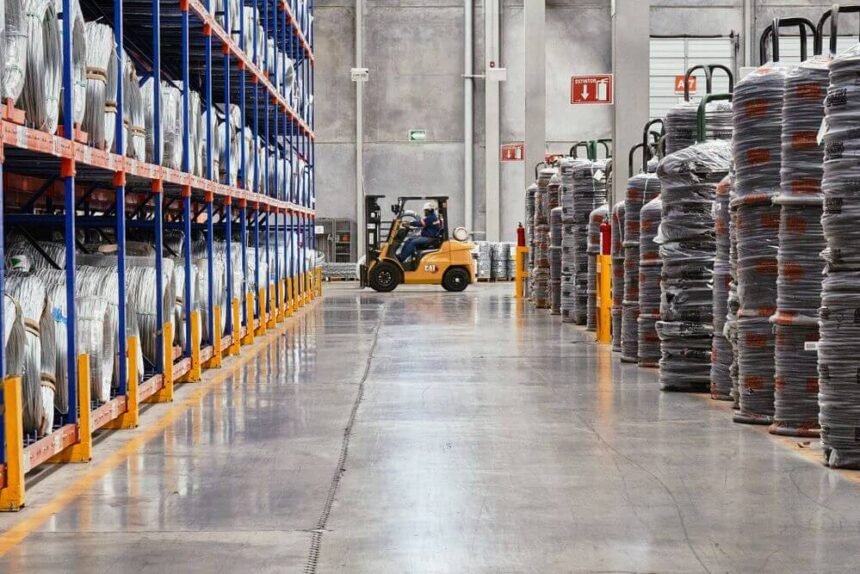
The lead item of any new store construction or conversion should be a computerized layout of racking, inventory, staffing, and lighting (and HVAC and power), coupled with cost/benefit analyses that look both up- and downstream at paybacks. The dollar savings in greater energy efficiency and product loss prevention, plus the avoided internal and external costs of unhappy customers and nasty suits, are easy to make the accounting case for.
Lighting is a performance metric, not a fixture choice
Many warehouse lighting designs are determined once, installed, and forgotten until something fails. However, good warehouse design dictates different light levels for varying tasks. The IES recommends roughly 500 lux for very detailed, high precision tasks, and roughly 300 lux for general, low-to-medium precision tasks. Conversely, the IES recommends less than 100 lux on inactive storage/bulk storage areas (IES Lighting Handbook). Active picking, packing, and shipping facility zones encounter all three types of tasks. Differences in lux level requirements vary by a factor of 5. To keep costs down, most warehouse storage and distribution facilities undoubtedly apply the inactive bulk storage requirements across all types of tasks, rather than zoning high requirements to expensive-to-light detailed tasks. One design fits all, and capacity (and usage) of the light varies by section.
Zone-by-zone lux targets: where most plans fall short
A warehouse isn’t one-size-fits-all when it comes to light levels. It’s a mix of different areas, each with its own requirements.
For example, in bulk storage aisles, light levels can be much lower because nobody’s trying to read a label from twenty feet up when the forklift is parked. A lower level saves a lot of power (remember, you double the distance, you quarter the light, because physics loves the inverse squares law and low cubbyholes away from the light won’t get much anyway) and bulbs because you can space them much further apart.
By contrast, active picking (or for that matter, any kind of quality control area, binning area, manual sortation area, etc) needs to be brightly and evenly lit with high color rendering and low flicker to within an inch of its life. Inactive picking (dead stock, returns, low rotation or overflow stock) and the break room can be a bit dimmer, but still need better lighting than aisle storage because someone will be trying to actually read things – although as the mandatory workflow there might be reading a packing list rather than as a real-time critical time performance metric like with convergence picking that does not require precision, you might get away with somewhat dimmer lighting.
The truck-loading area at the docks will probably get some light bleed from the truck itself (you already need to have running lights and supposedly, there are people who avoid actually turning off the truck engine entirely just to keep the lights on), but still should be very brightly lit.
But this is not an excuse to design an overlit warehouse. Too much illumination in the wrong spot is often as dangerous or inefficient as too little in the right spot, for obvious reasons.
LED high-bays: the retrofit decision that pays for itself
Older warehouses with HID or high-pressure sodium fixtures have a hidden expense which is heat. These fixtures produce a lot of thermal load, which leads to higher cooling costs in summer and makes the upper warehouse levels very uncomfortable. When you replace those fixtures with LED high-bay luminaires, the heat output goes down significantly.
Another benefit is that the light quality improves a lot. The color rendering upgrade is often overlooked. The CRI of older fixtures is so low that some colors, especially reds and blues that are often used in color-coded bin systems, are poorly represented. Workers struggle to read labels or the colors of the bins under these conditions and that results in picking mistakes. LED fixtures with a CRI of over 80 and as close to 90 as possible eliminate this problem.
When you’re designing a new fit-out, you will most likely choose LED high-bays. If you’re already in a facility and have to decide between retrofitting to LED or sticking to the old fixtures, you’ll probably make this decision based on energy savings and maintenance reduction (LED fixtures have a much longer lifetime compared to HID lamps, which means far fewer service visits to change a bulb 8 meters up in the ceiling). Once you factor in the cooling savings, the business case for a retrofit is pretty clear in most situations.
Zone-based controls: cutting energy without cutting safety
Lighting an entire warehouse at full output around the clock is wasteful, and it’s also unnecessary. Zone-based lighting controls – motion sensors paired with scheduled dimming – let low-traffic storage aisles sit at reduced output or switch off entirely until someone walks in, while active picking and packing areas stay lit to spec throughout the shift.
This isn’t a compromise on safety. It’s the opposite: full lighting stays exactly where people are working and moving equipment, while energy gets saved in aisles that see a forklift pass through once an hour. Daylight harvesting adds another layer here, particularly in facilities with skylights or large dock openings. Sensors can dim artificial lighting when enough natural light is coming through, cutting the load further. The one thing to watch is glare – skylights positioned badly can create bright patches that interfere with barcode scanning or create shadow contrast that’s worse than uniform artificial light. Glare management needs to be part of the daylight harvesting design, not an afterthought fixed after complaints start coming in.
Power distribution: designed around equipment, not convenience
Lighting may get the majority of the fanfare since it’s a visible element in any warehouse or manufacturing environment, but it is in no way more critical to operations than the power distribution.
Yet power may get short shrift in the planning stages as the racking goes in and the conveyor systems get designed. This is your regular reminder that the juice which powers your operation is every bit as important, if not more so because it’s less forgiving if mistakes are made early in the design and construction phases.
The mistake we probably see the most often is a power layout that is designed based upon where it’s easiest to run conduit or wire, rather than where equipment will actually sit and need to be plugged in. Receptacles, panels, and even circuits need to be planned with reference to the racking plan and the equipment layout. This means thinking about charging stations for forklifts and pallet jacks, where the scanner docks are, where conveyor drives are going, and any automated guided vehicles that are going to be running fixed routes through the facility. AGVs in particular require the most careful planning and forethought, as they need stable, flicker-free power, and dedicated circuits as voltage fluctuation or lighting flicker can affect their operation by interfering with their sensitive electronics and navigation equipment.
Getting the design and install right
All of this is invisible to you, the person shopping for an electrical contractor to install your warehouse power and lighting. But it’s what you’re really buying when you source professional installation.
This is where bringing in a contractor experienced in industrial lighting sydney work earns its cost – an electrician who’s done warehouse fit-outs before will spec zones correctly the first time, understand how to balance three-phase loads against a real equipment plan, and know what the local wiring standard (AS/NZS 3000 in Australia) actually requires for a facility of this type.
Load balancing across three-phase supply
Warehouses commonly use three-phase power to operate. Maintaining a similar load across the three phases is important. It can easily be the case that one phase carries a lot more load than the other phases due to the unplanned addition of new equipment. The consequences of this are overheating in cables and panels, nuisance breaker trips, and voltage sag.
Nobody cares much about voltage sag until it resets a terminal mid scan or causes a conveyor motor to trip mid-cycle. In a warehouse with automated picking or a conveyor system, an unbalanced phase is not just an electrical inefficiency, it’s an imminent production interruption. Phase balancing must be checked when designing the system and should be checked again whenever new equipment is added to the floor.
Backup power for the systems that can’t go down
A power loss while processing a transaction with a warehouse management system server can result in damaged inventory records. Mobile computing stations and hand-held scanners losing power in the middle of a shift brings your pickers to a stop. Automated conveyors that simply stop rather than receiving a clean shutdown sequence can quickly become jammed or can damage goods.
An uninterruptible power supply is there to protect exactly those sorts of pieces – the bits of the infrastructure where even a small break causes a lot of disruption. UPS systems are also sized to protect your actual critical load, not just the room filled with racks, and they need a maintenance schedule because a UPS with a dead battery is worse than no UPS at all, because it gives a false sense of security.
Emergency lighting and the commissioning walkthrough
Exit path lighting is not a nice-to-have feature that can be installed at a later date – it’s a critical part of any new warehouse construction. Your DC (distribution center) will legally need to have minimum levels of safely-lit space, and the only way to prove you’ve met that requirement is with pre-opening commissioning tests to get official, sign-off data.
Get halfway through the year and there’s an insurance audit or accident investigation against you and they’ll be looking for paperwork that proves you tested and documented that your emergency and exit path lighting worked, in compliance with codes and design specifications. If you can’t provide it they won’t just write you up, they’ll also put you in the lawsuit’s pile of “obviously negligent, no-defense” defendants.
The takeaway for opening day
Lighting and power distribution should not be taken for granted as systems in the background – they play a direct role in the day-to-day functioning of warehouse operations. Defining proper lux levels and ensuring a balanced electrical load can make a significant difference in the accuracy and uptime of picking, packing, and equipment in a warehouse. Identifying and protecting systems that can’t tolerate an outage in advance and conducting a thorough walk-through before operations begin can make the difference between a first shift that runs the way it’s supposed to and one that doesn’t.