

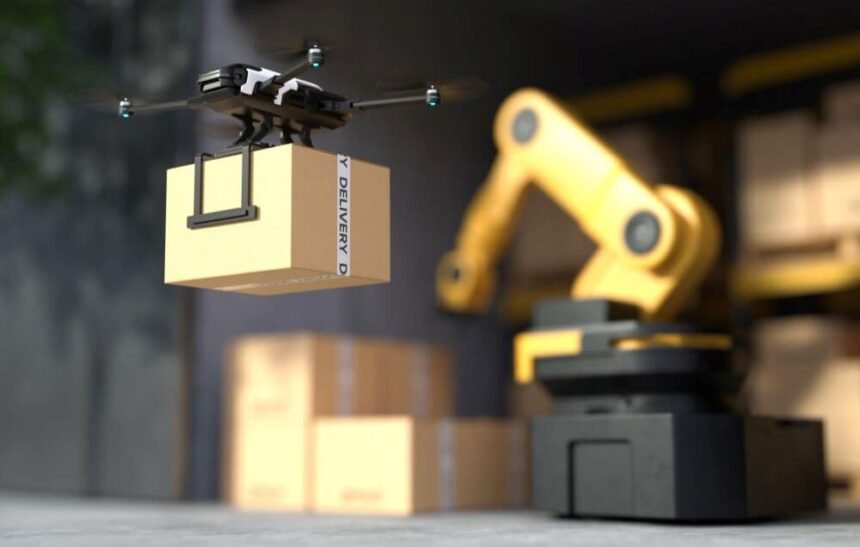
Most modern warehouses and factories already have cameras everywhere. Cameras read barcodes. Cameras watch for safety incidents. Cameras inspect product as it comes off the line. The cameras handling these jobs see in two dimensions, which means they capture an image but cannot tell how far away anything is. That gap matters more than it sounds. A flat picture cannot measure how full a parcel is, cannot guide a robot to a randomly placed object, and cannot check whether a moulded part is shaped correctly. This is where 3D cameras have started to quietly take over.
What a 3D camera actually does
A 3D camera captures the same scene as a regular camera, but it also records the distance from the lens to every point in view. That depth information turns a flat image into a digital model of the scene, often called a point cloud, that a computer can measure, rotate, and analyse.
For machine vision, that is a big deal. A robot can now reach into a bin of mixed parts and pick the right one because it knows exactly where each surface sits in space. A logistics line can measure the volume of a package without putting it on a scale. An inspection system can tell whether a moulded part has warped, even if it looks fine in a flat image.
Engineers choosing this kind of hardware look for a 3D camera for machine vision that fits their specific working distance, accuracy, and environment. The right device for picking small parts looks different from the right device for measuring pallets.
How Do 3D Cameras Actually See Depth?
There are a few main technologies, each suited to a different job.
- Stereo vision uses two cameras spaced a fixed distance apart. The system compares the two images and calculates depth the way human eyes do.
- Structured light projects a known pattern of dots or stripes onto the scene. The camera measures how the pattern bends across each surface to reconstruct shape.
- Time-of-flight cameras send out a pulse of infrared light and measure how long it takes to bounce back from each point in the frame.
- Laser triangulation scans a thin laser line across an object and tracks where it lands on the sensor.
Each technology has trade-offs in accuracy, range, speed, and cost. A short-range bin picking application typically uses structured light. A long-range mobile robot may use time-of-flight. A high-precision inspection bench often uses laser triangulation.
Where 3D Cameras Are Showing Up in Business
These devices are no longer research equipment. They are mainstream tools in several common business settings:
- Warehouses and parcel hubs, where dimensioning systems measure every box and calculate freight pricing without manual handling.
- Logistics centres, where palletising robots stack mixed-size cartons by reading the 3D shape of each one.
- Manufacturing lines, where vision-guided robots pick parts from unsorted bins instead of relying on precise feeders.
- Quality control, where moulded plastics, welded assemblies, and printed circuit boards are measured for warp, alignment, and dimensional drift.
- Food and agriculture, where products are graded by volume and shape, not just colour.
- Safety zones, where 3D cameras detect when a person enters a robot work envelope and trigger a slowdown before contact.
- Medical and life sciences, where 3D imaging of samples and devices supports quality and traceability.
The pattern in all these settings is the same. A 2D camera tells the system what something looks like. A 3D camera tells it what shape it is and where it sits.
Why This Matters for Small and Mid-Sized Operators
3D vision used to belong to large industrial buyers. The hardware was expensive, the integration time was long, and the software was specialist. That has changed in the last five years. Plug-and-play models now cost in the low hundreds of dollars, ship with standard interfaces, and integrate with popular robotics frameworks out of the box.
That puts 3D vision within reach of operators that were previously locked out. A small manufacturer that wanted to automate bin picking five years ago needed a six-figure system integrator. The same operator today can buy a structured-light camera for a few hundred dollars and pair it with an open-source pick planner.
The opportunity is sharper for businesses that handle variable products, irregular packaging, or fragile goods. These are exactly the cases where flat 2D imaging breaks down and humans end up doing the work. 3D vision automates that work cleanly, and the savings show up quickly in payroll, throughput, and damage rates.
How to Choose the Right 3D Camera
Three quick questions narrow the choice:
- What is the working range? Bin picking and small-part inspection sit within one metre. Pallet measurement and warehouse mapping run from two to five metres. The technology choice changes with range.
- How accurate do measurements need to be? Sub-millimetre precision means structured light or laser triangulation. Centimetre-level precision for logistics often allows the use of cheaper time-of-flight cameras.
- What is the operating environment? Indoor controlled lighting is forgiving. Bright outdoor lighting interferes with some technologies and is fine for others. Industrial dust and washdown demand sealed housings with IP67 ratings.
Most vendors publish working range, accuracy at a given distance, and frame rate on their data sheets. Comparing those three numbers against the application requirements narrows a long shortlist to a workable one in minutes. A short proof-of-concept on the exact part or parcel that the system will see in production is the final check before commitment.
The Bottom Line
3D cameras have moved from specialist labs into everyday warehouses, factories, and logistics hubs. They handle the jobs that flat cameras cannot, and the price point now makes them reasonable for businesses outside the Fortune 500. Operators that handle variable shapes, fast lines, or mixed product runs will see the biggest gains. A short pilot on a real use case is usually enough to show whether the math works for a given operation. The technology is no longer the constraint. The constraint is whether a business has noticed that the constraint is gone.