

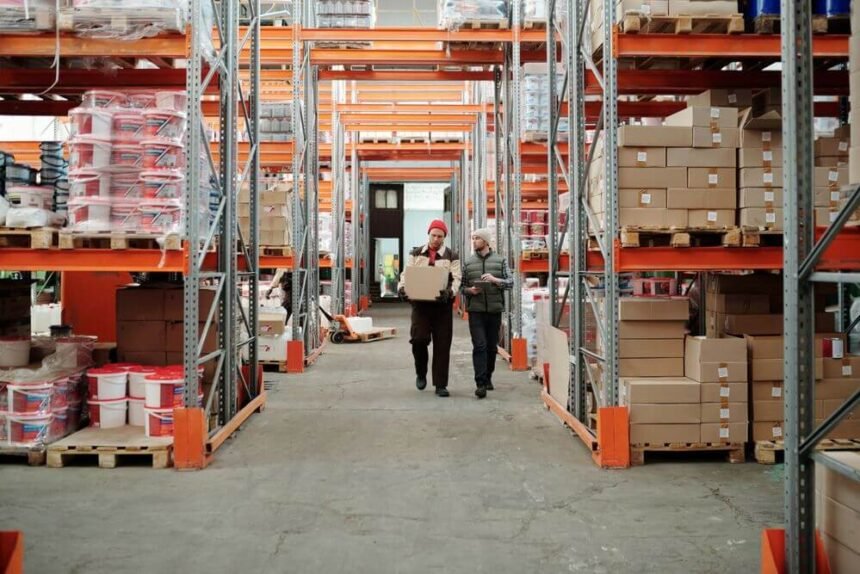
Shipping delays are no longer exceptional occurrences – they’re just part of the schedule that you need to account for. Organizations treating each and every disturbance as an unanticipated event will be responding for a fortnight. Those that incorporate resilience into their network will take the blow and roll on.
Start By Mapping Where You’re Actually Exposed
Many operations teams know their tier-1 suppliers well. But fewer know which port their freight moves through, which rail ramp handles the next leg, or which single carrier covers the last fifty miles to a distribution center. That gap is where delays turn into full stoppages.
Map the route on paper, from raw material origin to final delivery dock. Highlight every point where volume funnels through one supplier, one carrier, or one facility. Those are your chokepoints. A port with no drayage backup, or a warehouse served by a single trucking contract, will stall your whole operation the moment something goes wrong there. You don’t need software to do this exercise – a whiteboard and an honest inventory of your lanes will surface most of it.
Size Your Buffer Against Variability, Not Averages
Too much inventory planning still relies on average lead time to determine reorder points. That’s the wrong number. Average lead time tells you what happens on a normal day. It says nothing about what happens when a normal day doesn’t show up.
What matters is the spread. Look at your last two years of shipment data and find the range between your fastest and slowest deliveries on each lane. Set your safety stock against the slow end of that range, not the midpoint. This is the difference between running lean and running fragile. Just-in-time works perfectly fine when lead times are predictable. It breaks the moment a disruption stretches transit by even a few days, because there’s no cushion built into the system.
McKinsey’s 2020 analysis found that companies can expect a supply chain disruption lasting a month or longer once every 3.7 years on average, and that firms should plan for shorter, more frequent disruptions too. That’s a useful number for sizing buffer stock on your most critical inputs – it’s not a once-in-a-career event, it’s a recurring cost of doing business.
Build Redundancy Into Your Carrier Mix
Using only one provider because your volume isn’t high enough to split between two or more companies? Your internal cost consolidation is hiding the fact that an outage could mean lost revenue during a critical month – or, even worse, losing a key customer who doesn’t have time to wait. A higher rate, spread over two solid provider relationships, costs less than a lost opportunity.
The other advantage to already working with a diversified set of providers is that your main options are pros at hauling your products. For example, performers in the food and beverage industry rely on a carrier that has outstanding experience with refrigerated transport, the proper certifications, and a culture of food safety. Companies that partner with established trucking logistics providers as part of a diversified carrier base tend to recover faster from regional disruptions, because they’re not waiting on a single point of failure to clear before freight starts moving again. A solid #2 carrier or spot market load board could cancel out the service and product knowledge advantages your leading carrier provides if those first-time haulers can’t be trained fast enough to respect temperature requirements or avoid contamination.
Make Your SLAs Do More Work
Many service level agreements focus on on-time delivery without considering the true cost of a delay. In most cases, the real cost of a delay is total silence. When delivery is 4 hours late, and it’s reported to the customer right away, it’s manageable. But when you notice delivery is 4 hours late and eventually it didn’t make it, that’s a totally different story.
In this instance, negotiate SLAs to define the delay communication timeframe, responsible contacts for reporting problems, and define penalties for silences, not for delays. You’ll still need to measure OTIF. However, this should be complemented by a set of rules on how fast negative information needs to reach the top management.
See Problems While They’re Still Small
Dwell time at a port or rail ramp is one of the earliest indicators that a load may present a problem. If you have real-time telematics data on trucks and trailers and simple visibility tools, you can see that container or trailer deviate off course from its planned arrival while there’s still time to re-plan delivery or notify the receiver. Typically, demurrage and detention costs will quickly pile up, but by then it’s too late, since you’ve likely missed the customer window.
You don’t even need predictive capability to make this work. Just manually measure how long a lane’s typical load stays at a usually trackable location and do this once a week. Within a few weeks, you’ll see patterns – which port is regularly slow in which season, which carriers usually hit the last dock and stay for unaccounted time. This history is all you need to flag risk before it becomes a missed delivery date.
Diversify Sourcing On Your Most Exposed Inputs
If you think about it, single-sourcing is actually a choice you keep making every day. A product or an input that’s in the critical path for production with no alternative available is the same situation as being single-sourced – you just don’t have the luxury of short-term price negotiations to improve your position. The only difference is that you made the decision a while back, so you’re used to it. Identify those inputs and line up at least one alternative supplier and route that could be activated within days. You won’t use it often. When you need it, the lead time on setting it up after the fact is the thing that turns a shipping delay into a shutdown.
None of this prevents the next disruption. It just means the next one costs you a few days instead of a few weeks – which, over time, is the entire game.