

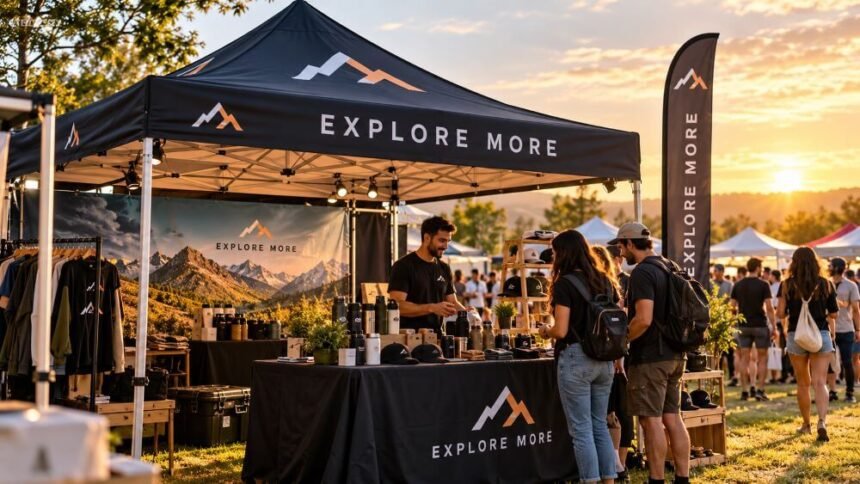
Ask anyone who does events regularly what the tent actually does, and you’ll usually get the same answer. Keep the rain off.
Fine. True, even. But it’s also the most expensive way to think about it, because the canopy is doing about five other jobs at the same time and nobody’s counting them.
Here, watch. Next event you’re at, stop for a minute and observe how people move. Nobody reads the banners on the folding tables. They look up. Which canopy looks like a real business, and which one looks like someone’s uncle lent them a temporary gazebo? That decision happens from about twenty meters away, and it’s made before your products even enter the picture.
Yeah. The tent is the branding. So let’s talk about picking one properly, because price and size don’t get you there.
How to Choose a Custom Tent That Fits Your Event and Brand
1. Start With the Event, Not the Catalog
The classic mistake, and honestly, everyone makes it once. Nice big tent, reasonable price—buy it. Get it home. Then real life happens, and it turns out the thing doesn’t fit the market pitch, is too much hassle for a two-hour school fete, and looks odd at the trade show.
So before looking at a single product page, write out the actual events. The real ones, the ones that repeat every year. Saturday market stall? Then what you need is speed, because you’re putting it up and taking it down every week, and you’ll hate anything fiddly by month two. Trade show once a year? Then visibility matters more; you’re competing against a hall full of other logos. Doing a product launch? Now it needs to look special. Sponsoring the village fun run? Visible from across the field, friendly, and approachable.
An hour with a notebook beats an afternoon on shopping sites. Sounds obvious; nobody does it.
2. Size to the Pitch, Not to Ambition
There’s a specific moment of humiliation known to every market trader. The marshal walks over and says your stall is two meters too wide for the spot.
Don’t be that person. Market pitches are mostly laid out for 10×10, which is a big part of why the 10×10 custom pop-up tent refuses to go away. It fits where it’s meant to go; a couple of people can have it up in ten minutes, and printed properly, it carries as much brand as structures twice the cost. If your calendar is full of smaller events, this is the tent that lives in the van. And a tent that gets used beats a tent that impresses on a spec sheet every single time.
Go bigger only when there’s a reason. Food stall with a queue, trade show double booth, or an activation with seating inside. Those need floor space, and they justify it. Everything else, extra size is just heavy.
3. The Print Is the Product
Ten meters from a white canopy with a banner cable tied on. Then ten meters from a fully printed one. Not the same thing at all, really.
But here’s where it gets technical and where the money gets wasted. How the print is applied decides everything. Dye sublimation heats the ink into the fabric itself, so it survives the sun, rain, and being shoved in a bag weekly for years. The cheap way just lays ink on the surface. That stuff cracks along every fold and goes pale after two summers outside.
And a half-faded logo is genuinely worse than a plain tent. At least a plain tent doesn’t say anything. A washed-out logo says the business gave up.
Where the print sits matters too, which people forget about. Branding on all four valence sides means the name reads from any direction someone walks in from. The printed back wall—that’s a photo backdrop for nothing. Canopy top printing? Sounds gimmicky until you’ve spent twenty minutes in a crowded field trying to find your own stall, at which point it sounds like genius.
For businesses that need this kind of flexibility, custom tents are available in different sizes and configurations, with options for printed canopy tops, sidewalls, and other accessories.
4. Some Events Need Spectacle, Not Just Shelter
Every so often, a normal frame tent isn’t the answer. Launches, openings, and festival zones. Events where the whole job is to make people pause and interact with your booth.
Inflatables are the tool for that. The sealed kind keeps its shape on its own, so there’s no blower droning away all afternoon, and setup is quick. Put one near a row of square metal frames, and it looks deliberate straight away, which is sort of the entire point. They also get photographed a lot. If social media is part of the plan, it can add a big chunk of value. Beige gazebo, nobody cares. Big inflatable shapes with your logo on them—people take pictures.
5. Buy for the Season, Not the Saturday
One last filter, and it might be the most important. How many times a year will this tent actually go up?
Because twenty weekends a year for four years and two weekends a summer are completely different purchases. Frequent use wants aluminum, not steel. Fabric that can take UV without going brittle. Stitching reinforced where the stress actually lands, mainly corners and sliders. And the bit everyone skips: check that you can buy spare parts separately. Feet, sliders, and replacement canopy tops. These things wear out on purpose; they’re consumables. A supplier who sells them separately means the frame keeps working for years and you’re only replacing the cheap bits.
The budget frame that bends in its second season quietly does all the money you saved. So look at the warranty first and the price second. Wrong order according to most people. Correct order according to everyone who’s replaced a tent twice.
End Point
Every tent can provide shade; very few can support your brand and marketing goals. Those tents can help people read your logo from across a field, find your stall without texting for directions, look good enough to get into the better events, and stay standing in year three. Start from the calendar, be honest about pitch sizes, pay for print that lasts, and match build quality to how often the van gets loaded. If that’s right, the tent becomes the marketing kit the business owns. Ask anyone who bought a good one. They’ll tell you the same thing.