

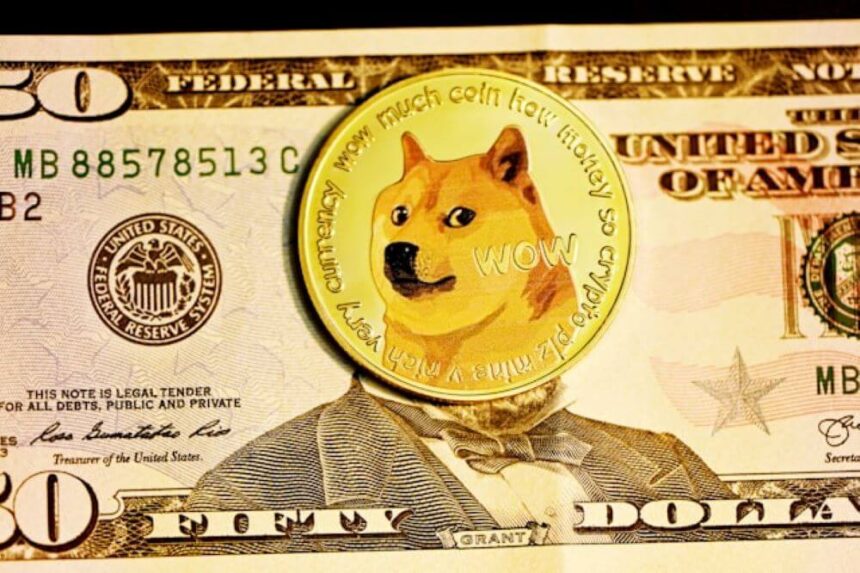
Dogecoin is among the first blockchains to launch as a “joke” chain but has evolved tremendously since then. In late 2024, it was more valuable than TRX and Cardano, a smart contracts platform, reflecting its popularity and growth. Dogecoin has maintained a robust value as the “first meme coin” due to its network features, and its celebrity endorsements have contributed greatly to its status. Moreover, Dogecoin has lower network activity and lower transaction fees, two features that attract many crypto enthusiasts. Naturally, everyone’s eyes are now on Dogecoin prediction for 2026 and beyond, so if you’re also interested in what the future holds for this meme coin, you’re in the right place. Below, we explore how this project could unfold further.
How is Dogecoin expected to perform in 2026 and beyond?
From a technical perspective, Dogecoin didn’t enter 2026 in a sustained uptrend, but in a clear corrective structure. More specifically, it didn’t hold above the $0.45–$0.48 resistance zone in late 2024, so it spent most of 2025 trending lower and forming a series of lower highs on the weekly crypto chart. The 2024 peak aligns with the 0.5–0.618 Fibonacci retracement zone, which served as robust macro resistance, and price rejection from that zone indicates that the late-2024 move was not the start of a new long-term trend but rather corrective.
Since that time, Dogecoin has retraced to a range of $0.14–$0.16, which is now a key mid-range support level. Momentum indicators also suggest a cautious view, with the weekly MACD rolling over again after a bullish crossover earlier in 2025. In a bearish scenario, a loss of $0.14 support would lead to a range between $0.10–$0.12, where previous demand clusters formed, while in a bullish scenario, a weekly close above $0.30 could shift things for Dogecoin. Considering the current technical structure, however, there’s a higher probability for Dogecoin to trade sideways or lower throughout 2026.
Dogecoin retains brand recognition in the meme coin scene, but it lacks the aggressive development cycles of competing networks. Without sustained on-chain growth and a robust Layer-2 roadmap, the meme coin is less likely to attract long-term capital than retail-focused and evolving meme platforms. But despite this, Dogecoin has demonstrated its resilience time and time again across different market cycles, and its deep liquidity and large holder base will probably not disappear anytime soon. In the long run, there will be several implications. Prior cycle highs above $0.70 are extreme outliers due to one-off speculative conditions, while long-term resistance lies between $0.35 and $0.50. From a conservative perspective, the long-term upside of Dogecoin is gradual rather than exponential, and immediate growth is unlikely.
What drives the price of Dogecoin?
Because Dogecoin has a thriving community, but at the same time, relies on its “pure memetic power, those holding DOGE should keep a close eye on the following factors:
- General market performance. It’s well known that, like most cryptos, meme coins perform well when the market is overall positive. Dogecoin hit its all time-high in early May 2021, and at that time, Bitcoin was also performing incredibly well, at around $70,000. This perfectly shows that crypto investors pour money into various digital coins during market rallies, and since it’s among the top projects, Dogecoin unsurprisingly gets some tailwinds.
- Whale activity. Crypto whales are addresses holding large amounts of coins, and their activity can temporarily distort prices due to the volumes they trade. For instance, how they move funds from centralized exchanges to non-custodial wallets can influence prices.
- Celebrity endorsements and usage. Elon Musk has been a driving force behind the price rallies Dogecoin has experienced over the years. In fact, throughout 2019-2021, his promotional activity was the single biggest factor supporting Dogecoin, making it an important factor to keep an eye on.
- Online user activity. Social media and messaging platforms, including Discord, X, and Telegram, constantly shape the future of meme coins like Dogecoin, so monitoring user activity on these platforms will help you spot trends of FOMO in bull run markets and FUD in bear markets, allowing you to make more informed choices.
- Competition. Dogecoin is the meme coin king, but investors have plenty of other cryptos to choose from. As this digital asset class sees increased adoption, with traders opting for less liquid options, the uptrend in Dogecoin could slow.
What are the most recent Dogecoin developments, and why do they matter?
Dogecoin has remained in the public eye, and for good reason, as it has undergone a few developments that may further shape its utility, adoption, and price outlook. In January 2025, the Grayscale Dogecoin Trust was launched, offering accredited and institutional investors alike the opportunity to gain exposure to Dogecoin without buying the asset directly. While this is associated with higher fees, the launch shows demand for structured investment products linked with Dogecoin. Around the same time, the Dogecoin Foundation launched the “Dogebox” initiative, an infrastructure project that enables merchants and users to accept Doge by providing a plug-and-play system that doesn’t require technical setup or third-party intermediaries. This initiative is an important step in positioning Dogecoin as a functional P2P payment method.
The bottom line
Dogecoin holds an important place in crypto history as the original meme coin, but in this market, historical relevance doesn’t guarantee future outperformance. Although this memecoin is one of the most popular assets in the market, with relevant use cases such as micro-transactions ideal for tipping content creators, factors like liquidity cycles and sentiment drive its price cycles, and not fundamentals. So, is it a buy? That depends on your goals, and whether or not you believe in it, but it’s essential to limit and size any exposure to it accordingly, approach it with caution, rely on independent research, and be aware that market dynamics can shift rapidly.